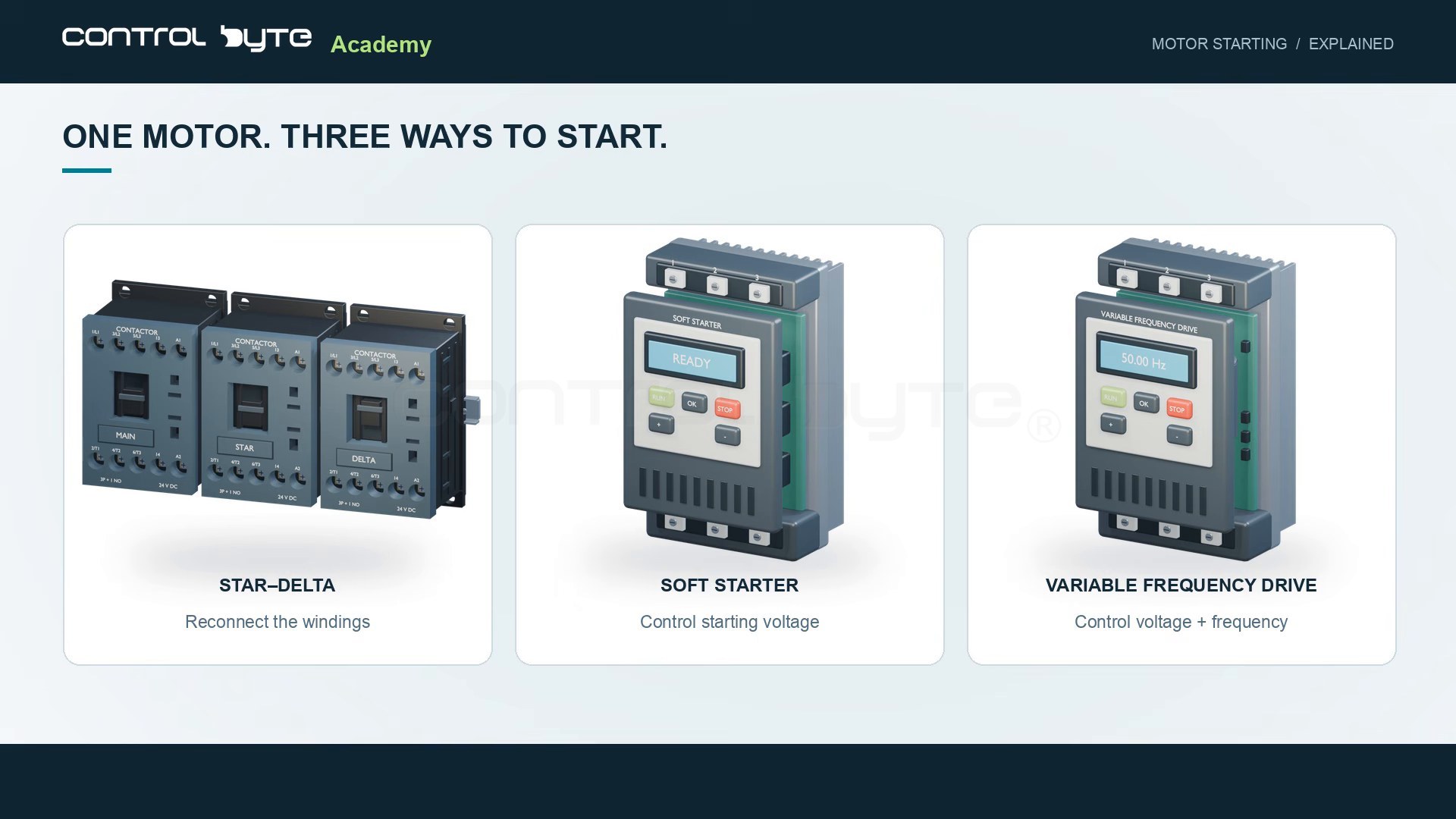
Star-delta vs soft starter vs VFD is one of the most common questions in motor control design.
A motor starts, the lights dip, the coupling takes a hit and the machine jumps into motion.
All three devices make that start easier on the electrical supply and on the mechanical load. But they solve different problems, and picking the wrong one costs money or torque.
In this article we look inside each device, follow what actually changes at the motor, and finish with a decision sequence you can apply to a real machine: a pump, a fan or a conveyor. If you are new to star-delta wiring, start with our Star Delta Starter: PLC Program, Wiring and Motor Basics guide.
Why Motor Starting Matters: Direct-On-Line Current
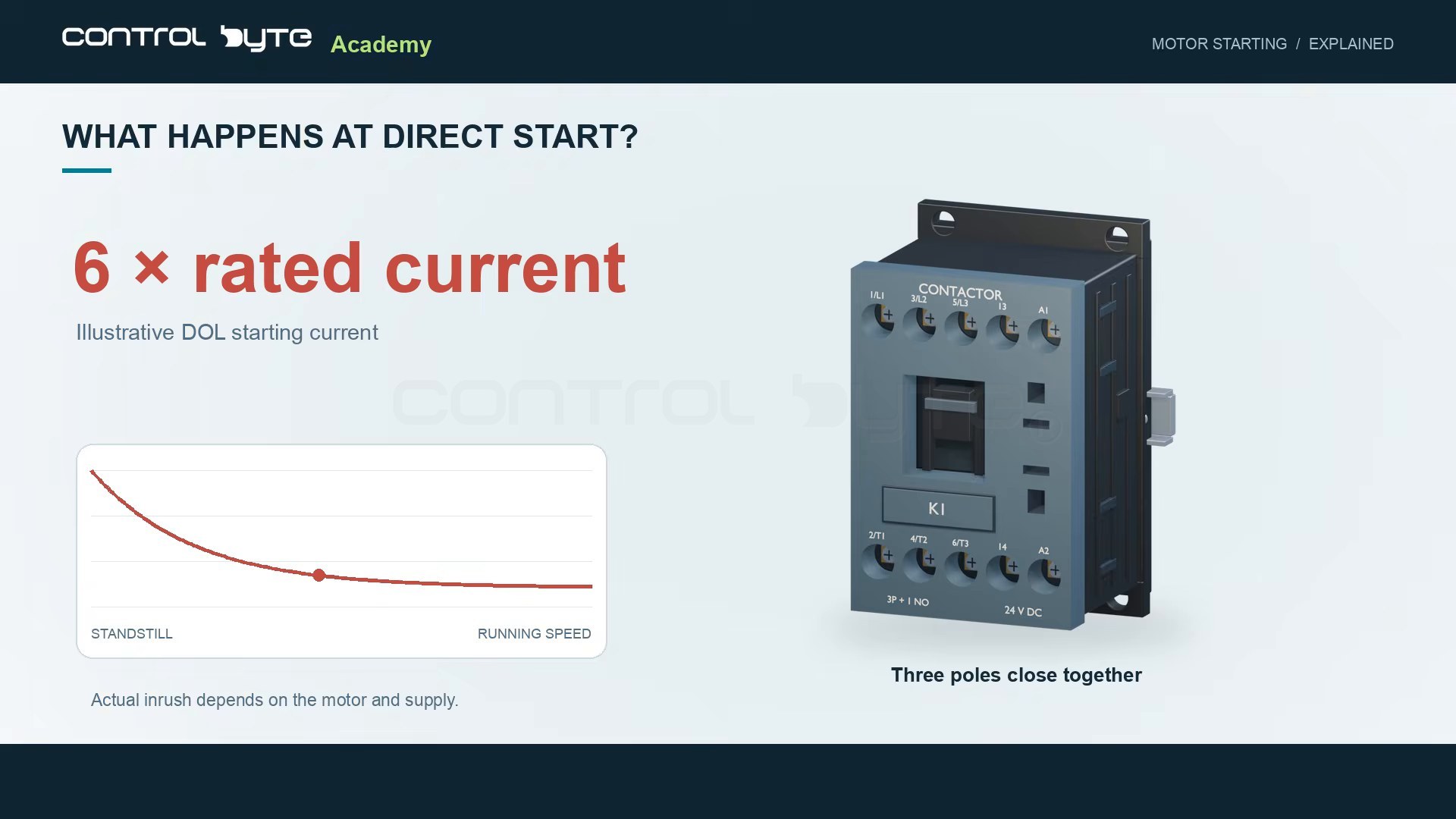
The simplest method is a direct-on-line (DOL) starter. A contactor closes all three power contacts and connects the motor straight to the supply.
At standstill, an induction motor can draw several times its rated current. Our illustrative example uses 6 × rated current, but the actual value always comes from the motor data. As speed builds, the current falls toward its running value.
Two rules apply to every starting method:
- the starting torque must exceed the load torque, or the motor cannot accelerate,
- a simple DOL starter is perfectly reasonable when the supply and the machine can accept that start.
If they cannot, you need a reduced-current start. That is where star-delta, soft starters and drives come in.
Star-Delta Starter: Check the Motor Nameplate First
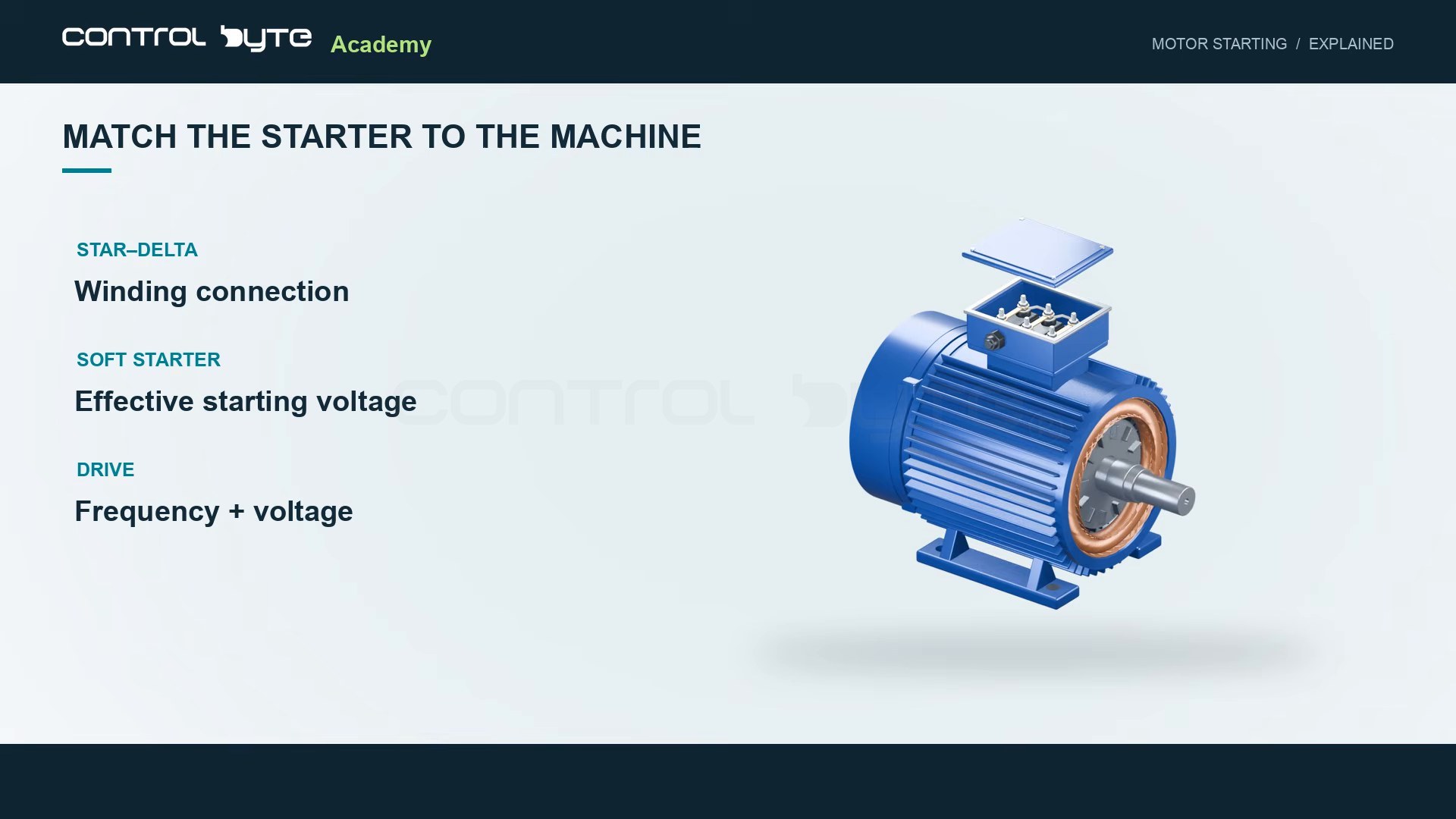
Before considering star-delta, check the nameplate and the terminal box. The nameplate decides which connection is possible.
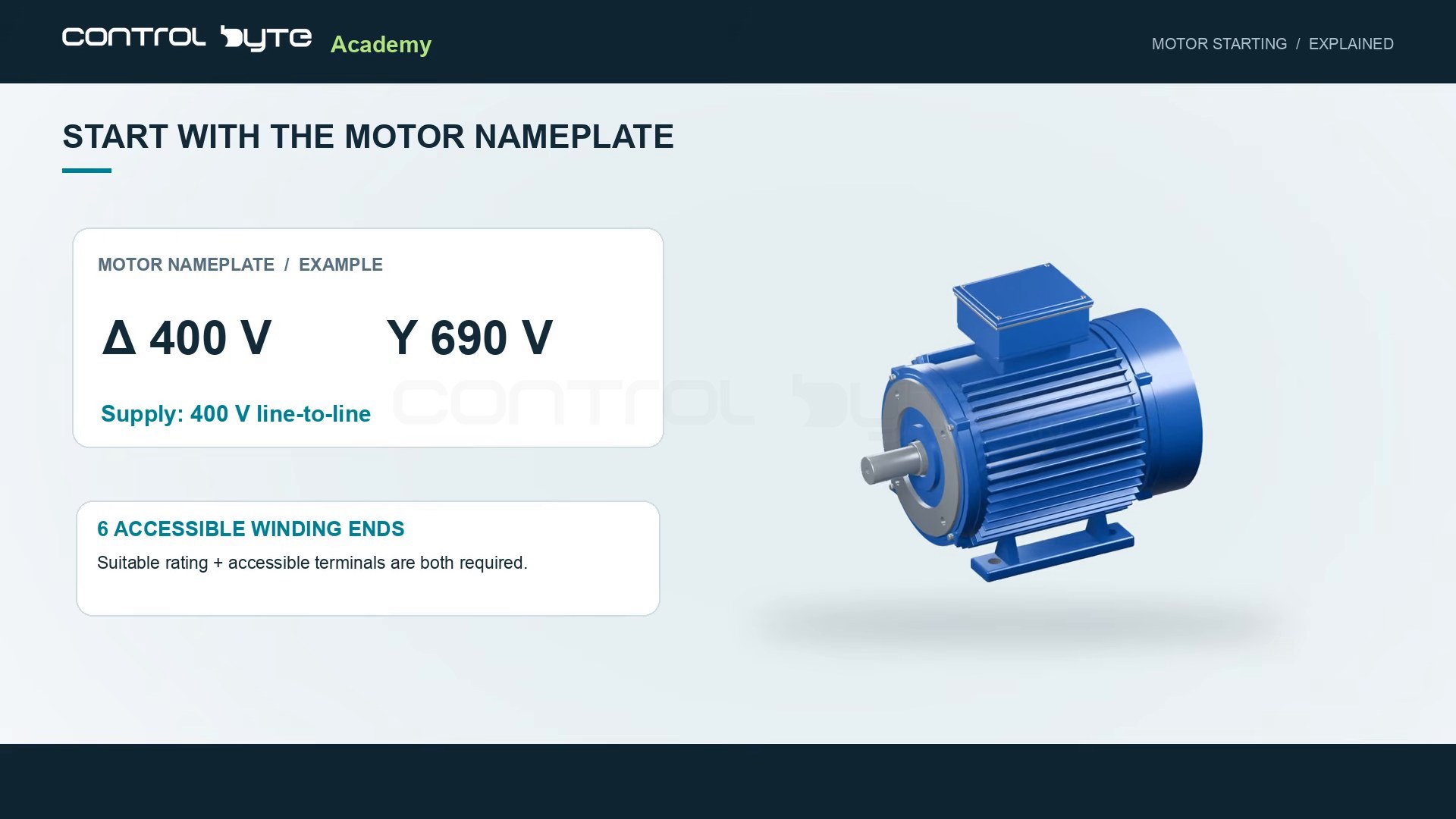
- On a 400 V supply, a suitable motor is typically rated 400 V delta / 690 V star.
- It also needs six accessible winding ends (U1, V1, W1, U2, V2, W2).
- A motor marked 230 V delta / 400 V star is different. Its windings are not rated for 400 V in delta, so connecting it in delta on a 400 V supply would overvoltage the windings.
Star Connection: Lower Current, Lower Torque
In star, the three winding ends join at a common point. Each winding receives the line voltage divided by √3, about 231 V on a 400 V supply.
Compared with direct starting in delta, this gives in the ideal case:
- about 1/3 of the line starting current,
- about 1/3 of the starting torque.
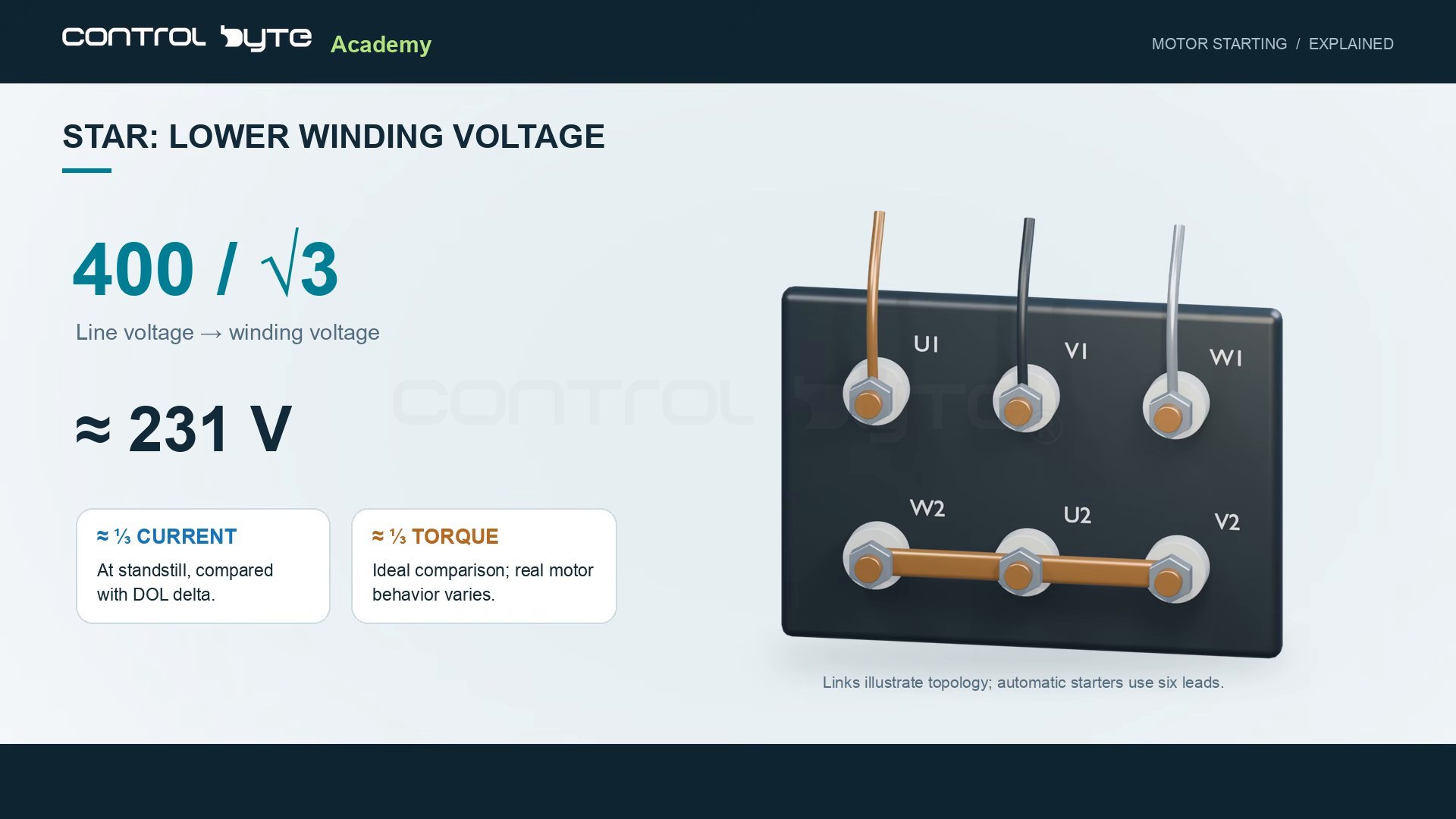
That is the trade-off. Reducing the electrical demand also reduces the torque available to accelerate the load. Actual performance always depends on the motor.
Star-Delta Changeover and Interlocks
An automatic star-delta starter uses three contactors:
- The main and star contactors close first.
- Once the motor has accelerated sufficiently, star opens.
- After a short open interval, delta closes. The main contactor stays on.
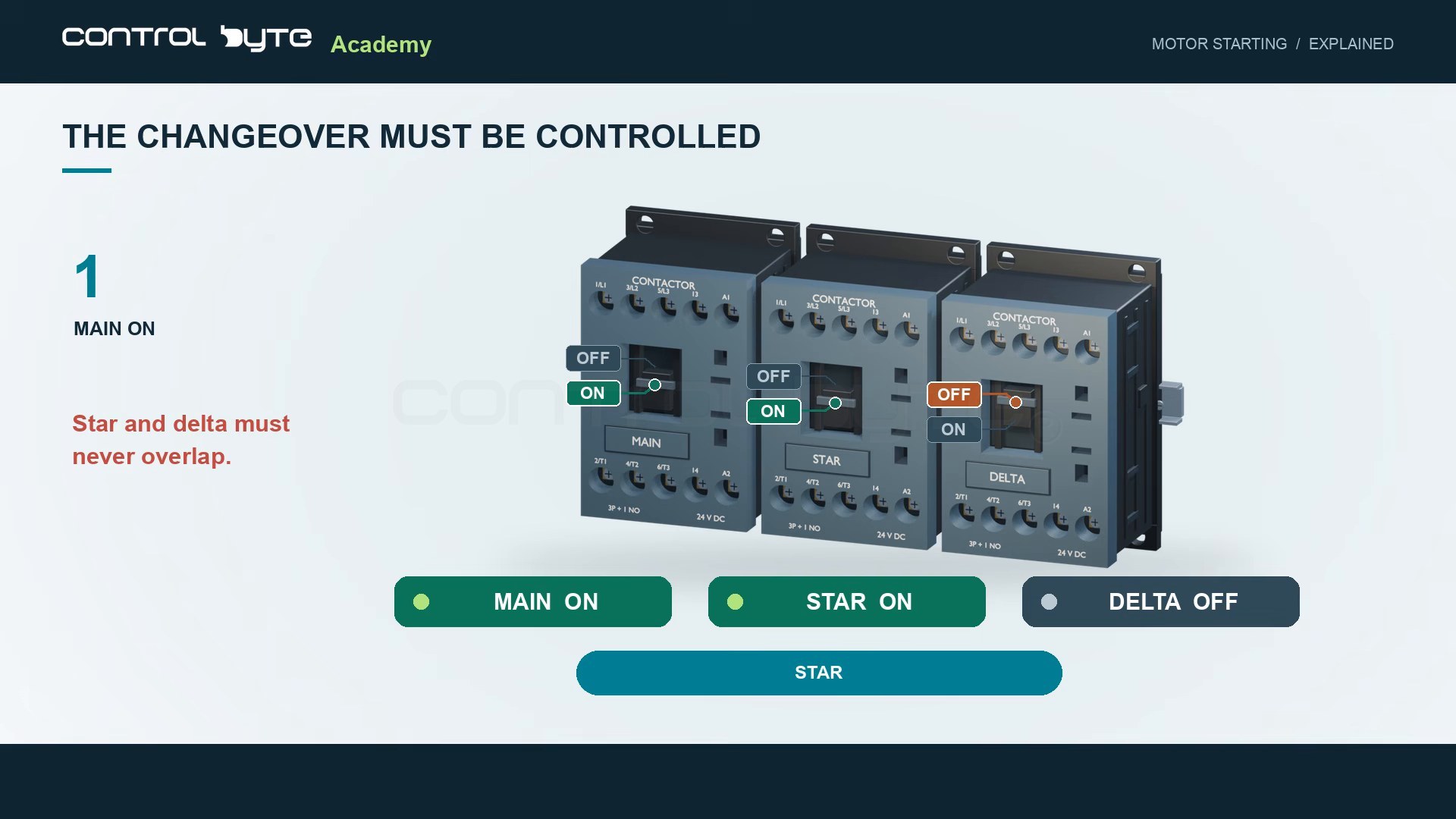
Electrical and mechanical interlocks must prevent star and delta from closing together. The changeover itself can create current and torque transients, so do not set the timer by habit. Verify acceleration under the actual load and follow the starter manufacturer's changeover requirements. You can see the full PLC program for this sequence in Star-Delta Starter Part 2.
Soft Starter: Controlling the Effective Voltage
A soft starter changes the way voltage reaches the motor. A three-phase controlled unit uses two anti-parallel thyristors in each phase.
By delaying the moment the thyristors turn on within each half cycle, it controls the effective voltage delivered to the motor. During the start the conduction interval increases, so the motor receives more and more voltage.
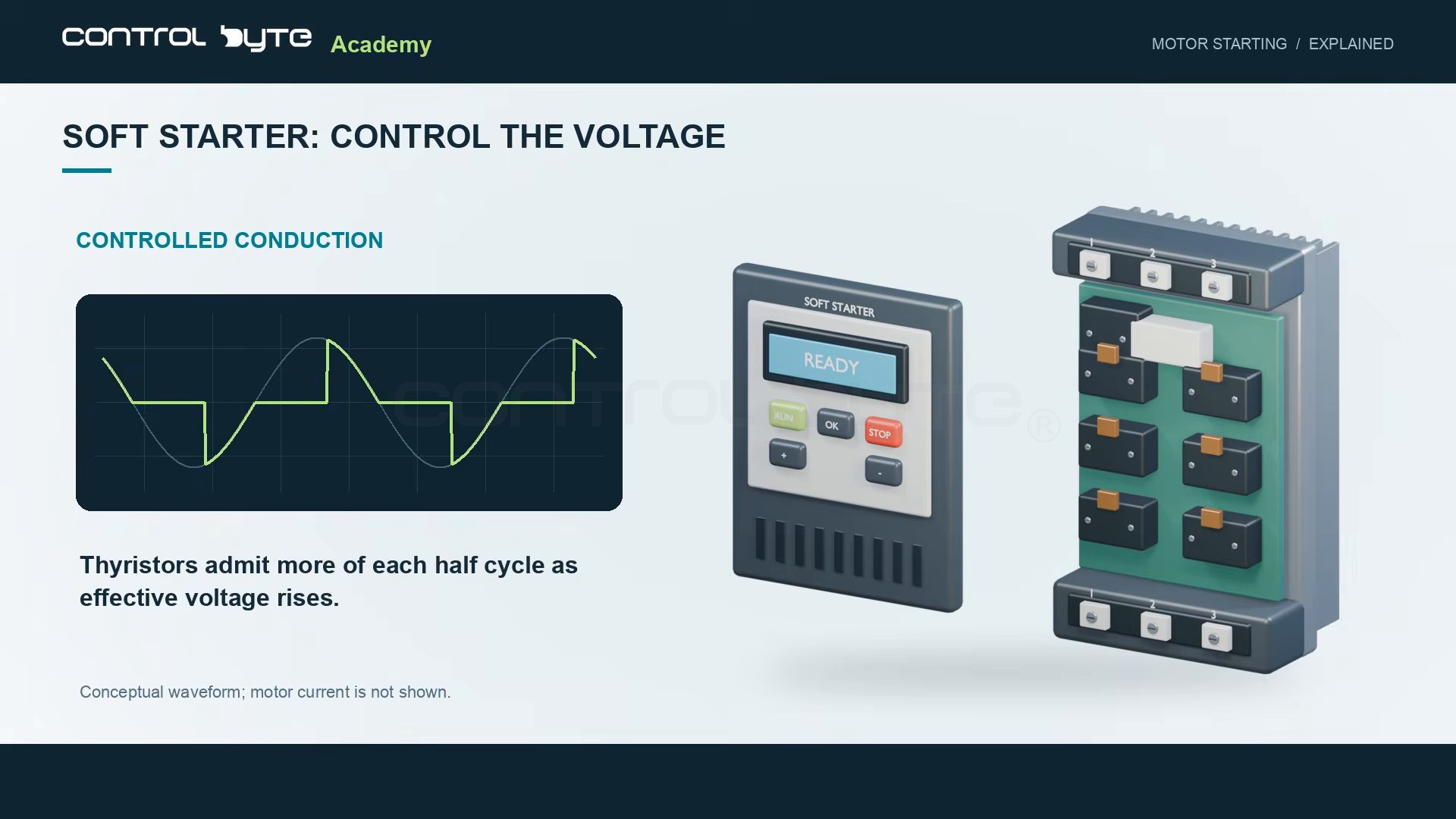
A current limit can restrain the electrical demand, but it must still allow enough torque for the machine to accelerate.
Why a Soft Starter Is Not Speed Control
Throughout the start, the supply frequency stays at 50 or 60 Hz. A conventional soft starter does not provide continuous variable-frequency speed control. After starting, the motor runs close to the speed set by the supply frequency and its pole count, with some slip.
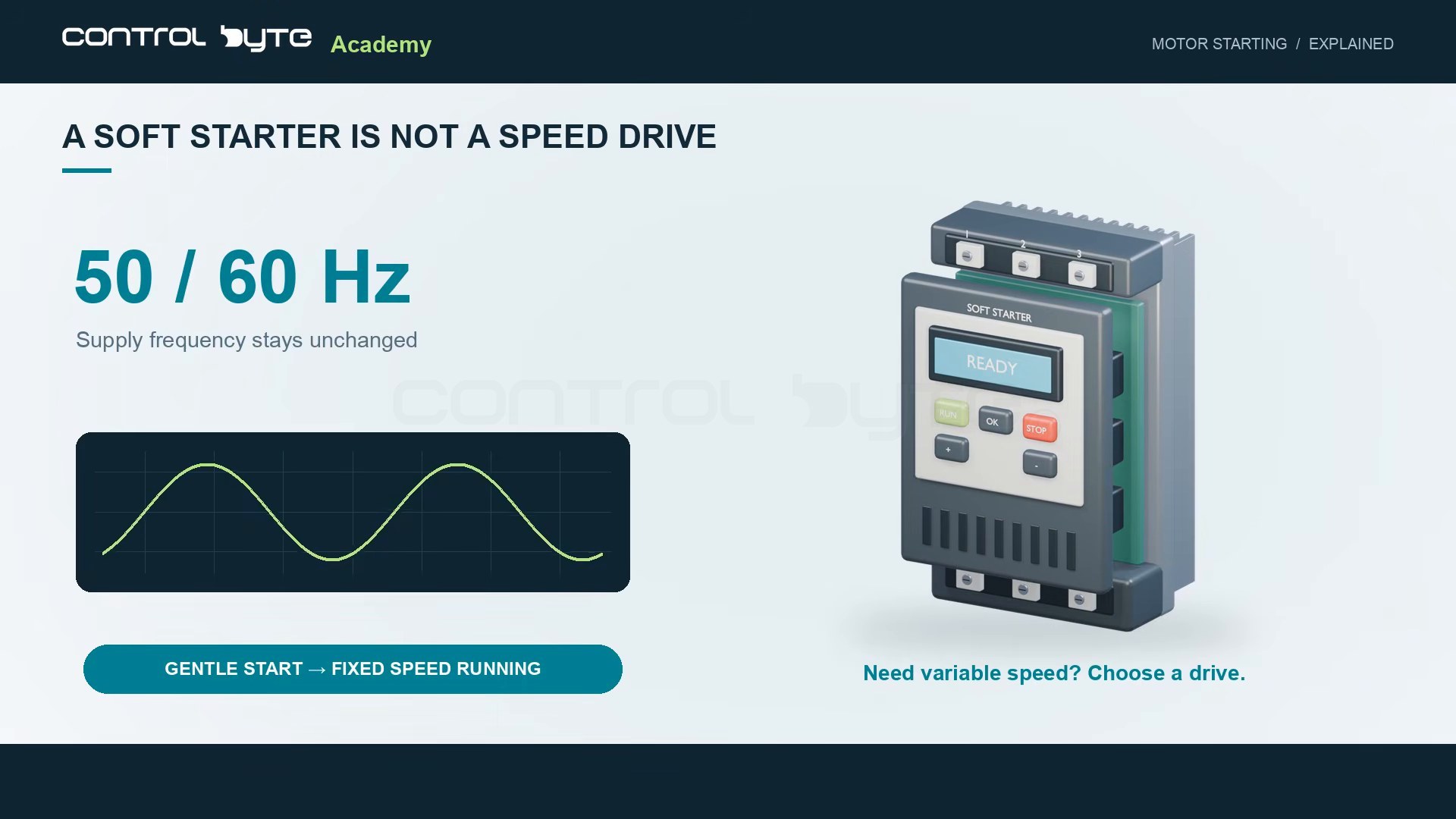
Lowering the voltage alone is not a substitute for controlling frequency:
- gentle start + fixed-speed running → a soft starter may be the better fit,
- different operating speeds (conveyor) or continuous demand following (fan) → move to a variable frequency drive.
Inside a Variable Frequency Drive (VFD)
A common voltage-source variable frequency drive has three main stages:
- Rectifier: converts AC into DC.
- DC link: capacitors store energy in the intermediate circuit.
- Inverter: a switching power stage synthesizes the motor output.
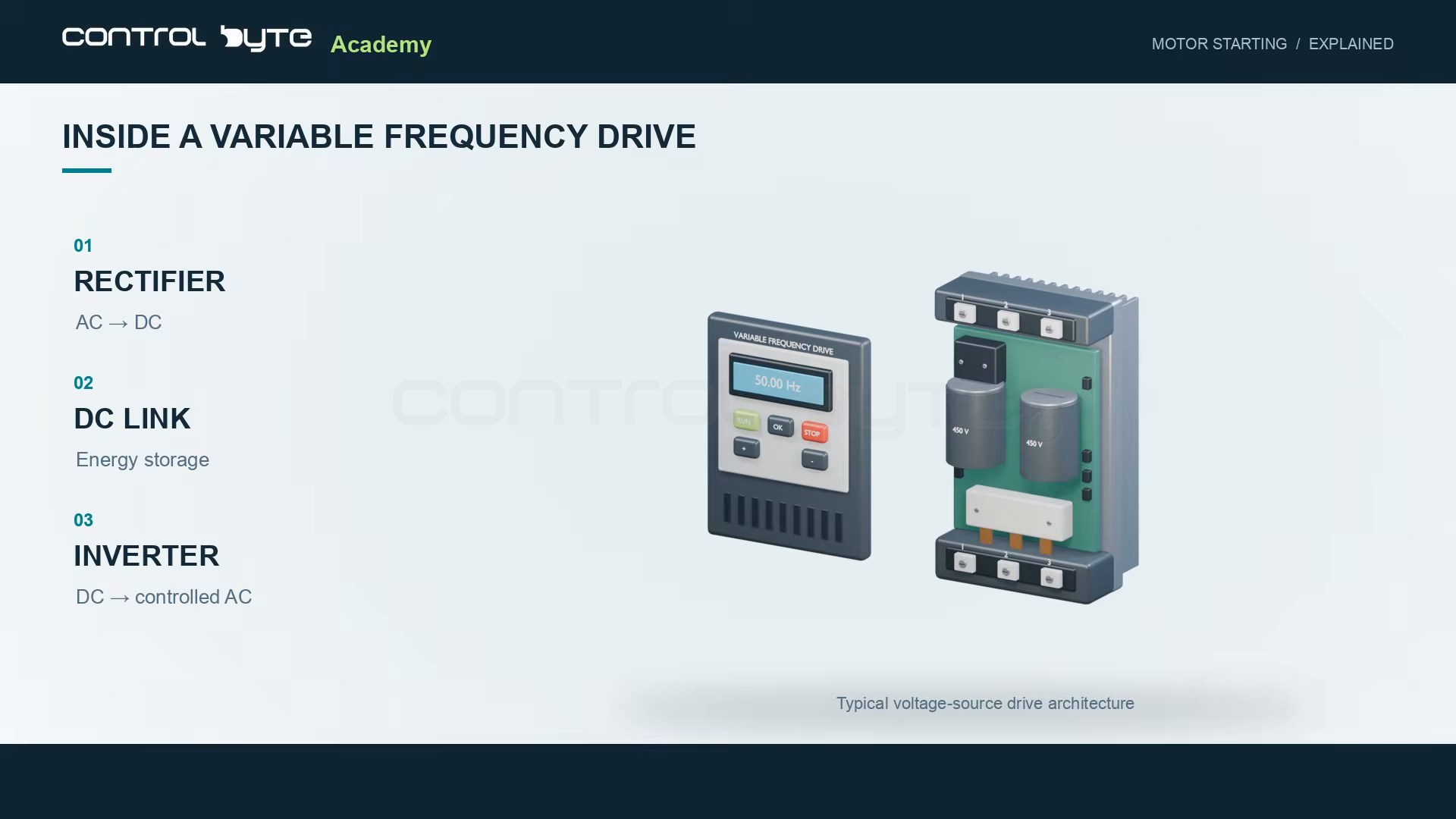
The power electronics do not simply reduce the incoming sine wave. They create a new output whose fundamental voltage and frequency can be controlled. Drive designs vary, but this architecture is a useful starting point. For a deeper look at motors and inverters, read our guide to modern drive technology or the general overview of variable-frequency drives on Wikipedia.
Frequency, Poles and Synchronous Speed
For an induction motor, synchronous speed is:
n = 120 × f / p
n - synchronous speed [rpm], f - frequency [Hz], p - number of poles
For a 4-pole motor, 50 Hz gives 1500 rpm and 25 Hz gives 750 rpm. The rotor normally runs slightly slower, because torque requires slip.
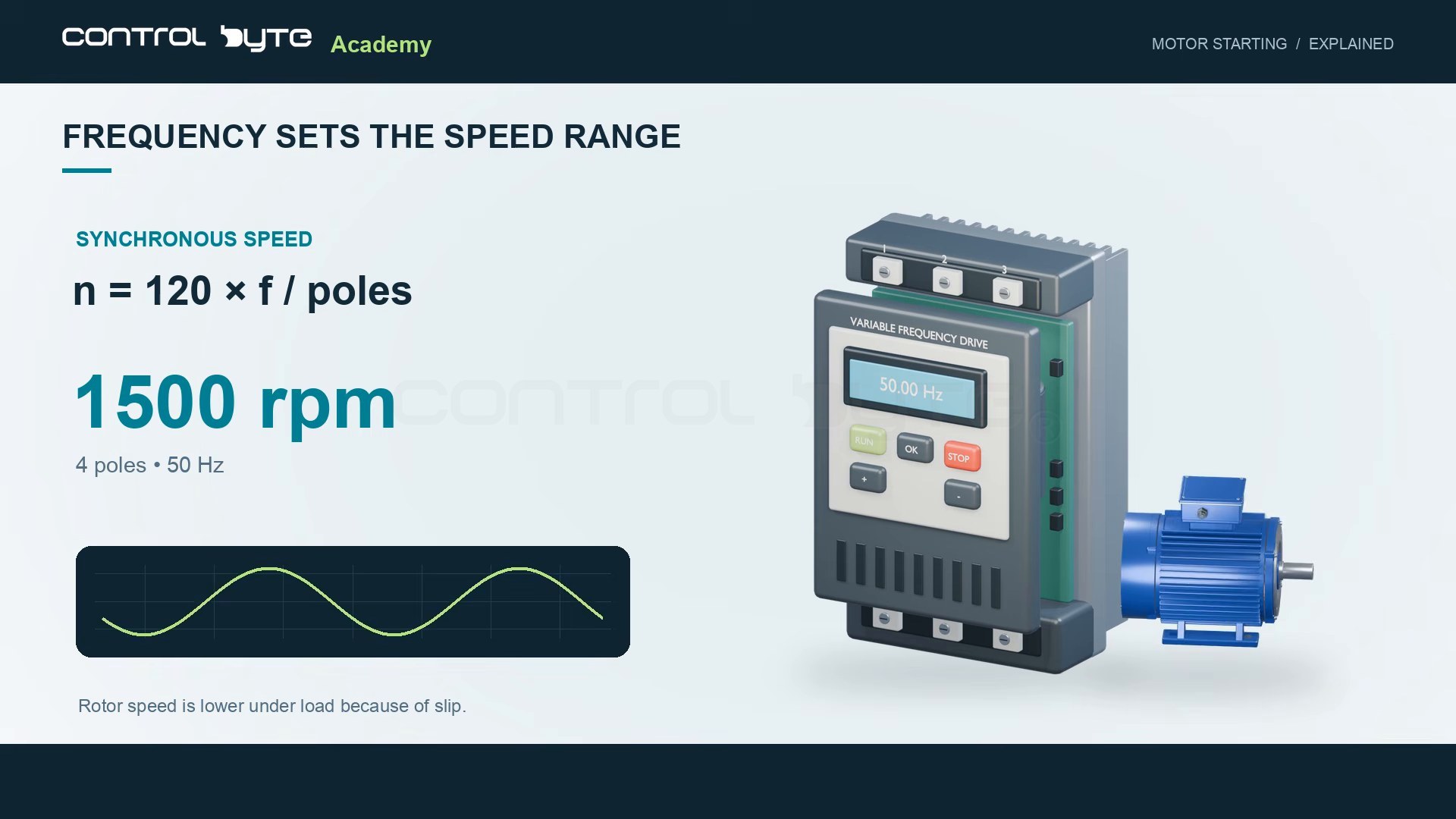
A drive changes the frequency and coordinates voltage or current control to produce the required torque. High torque at very low speed depends on the drive, control method, motor and cooling. It is not a promise every drive can make.
Pump vs Fan: Choosing for the Load
Choose the starter for the process, not the other way around.
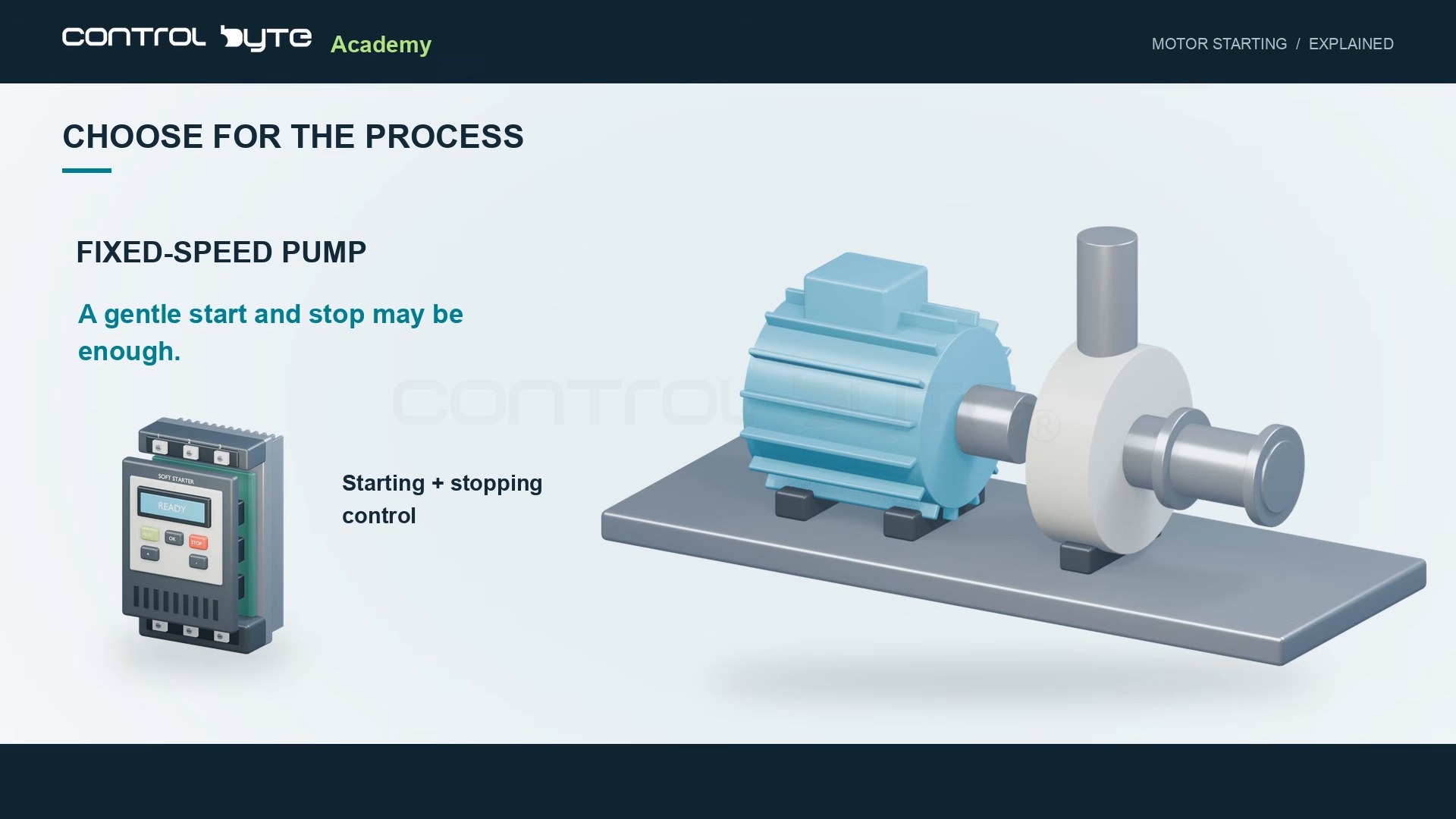
Fixed-speed pump. If the pump only runs at one operating speed and the concern is hydraulic shock at starting and stopping, a correctly selected soft starter may be sufficient.
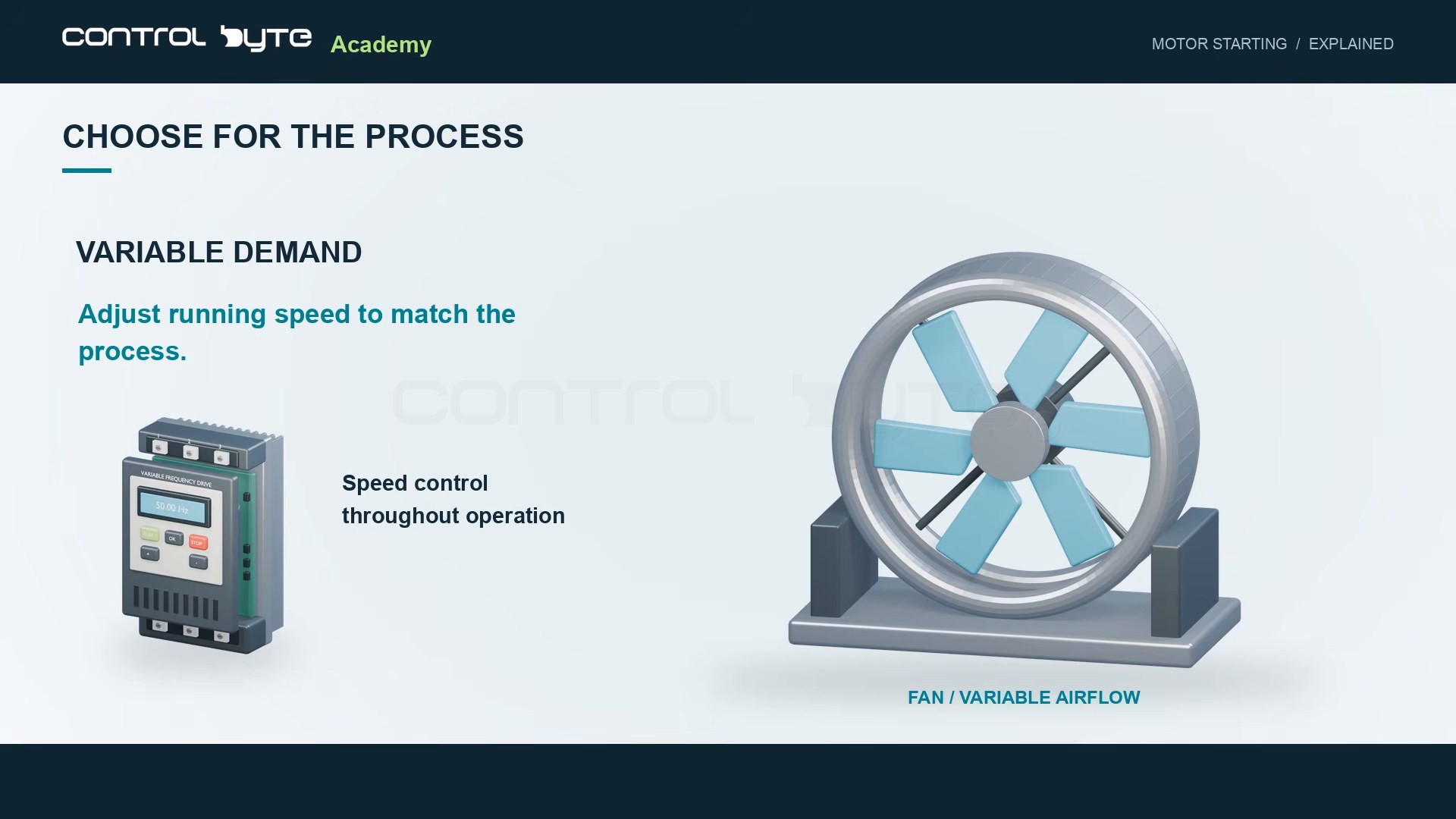
Fan with variable demand. If airflow demand changes throughout the day, a drive can reduce speed instead of wasting energy across a damper. For a suitable centrifugal load, reducing speed can substantially reduce power, but the actual savings depend on the system.
Lightly loaded, fixed-speed start. Star-delta may still be the most economical choice if the motor and the changeover behavior are suitable.
Star-Delta vs Soft Starter vs VFD: Comparison
| Feature | Star-delta | Soft starter | VFD |
|---|---|---|---|
| Start profile | Two connections | Adjustable | Adjustable |
| Running speed | Fixed | Fixed | Variable |
| Main capability | Reduced-voltage start | Controlled start and stop | Continuous speed control |
| What it changes | Winding connection | Effective starting voltage | Frequency and voltage |
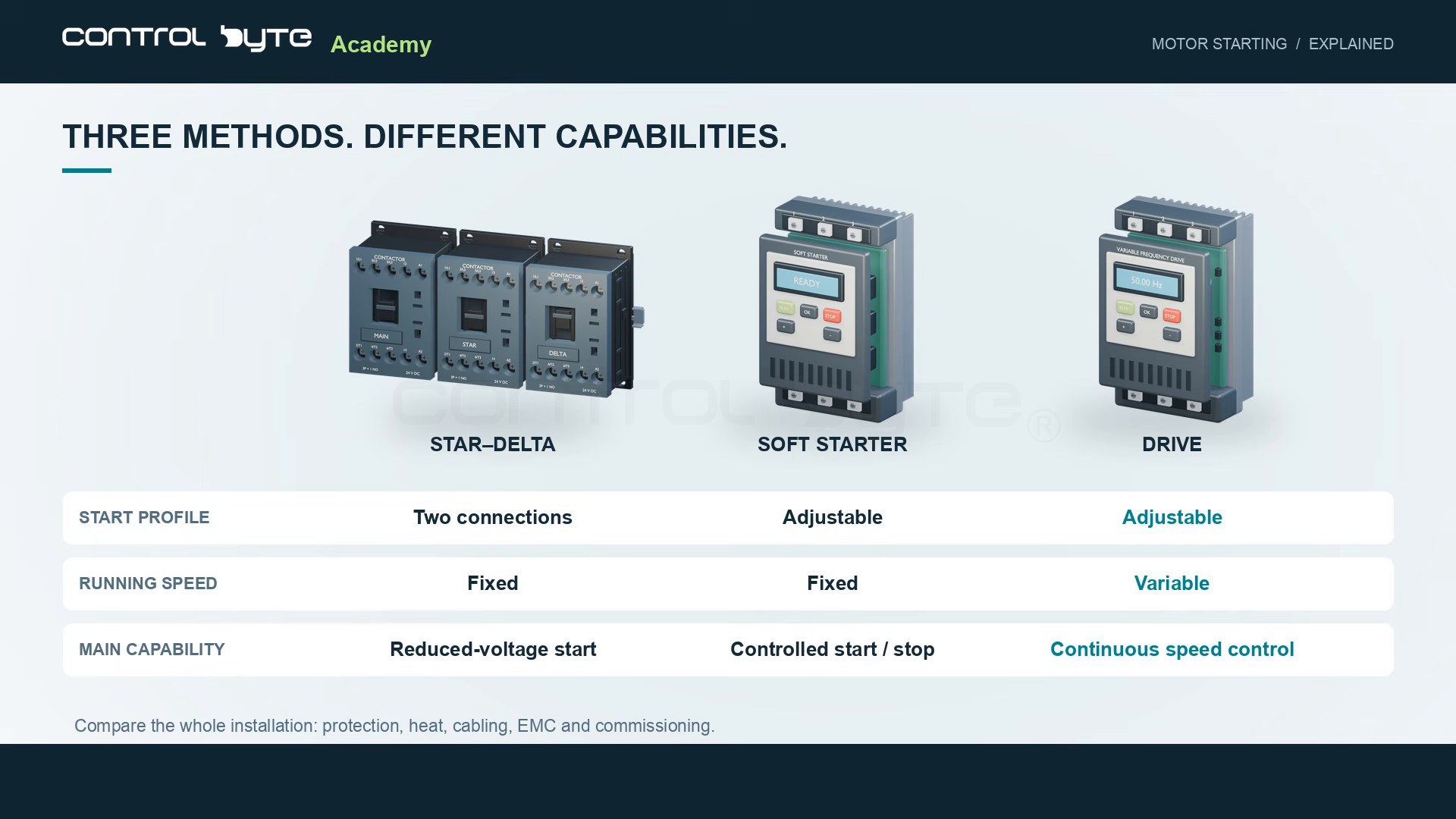
Compare the complete installation, not only the device price. Include contactors, protection, enclosure space, heat, cabling, electromagnetic compatibility (EMC), commissioning and maintenance. All three solutions still need appropriate protection and a design that matches the machine.
How to Choose a Motor Starter: Selection Sequence
Ask these questions in order:
- Must the operating speed vary during production? Investigate a drive.
- Fixed speed, but you need a gentle, adjustable start or a controlled stop? Consider a soft starter.
- Light load at start, a suitable six-terminal motor and acceptable changeover behavior? Evaluate star-delta.
- Finally, validate torque throughout acceleration, starting current, starts per hour and thermal limits.
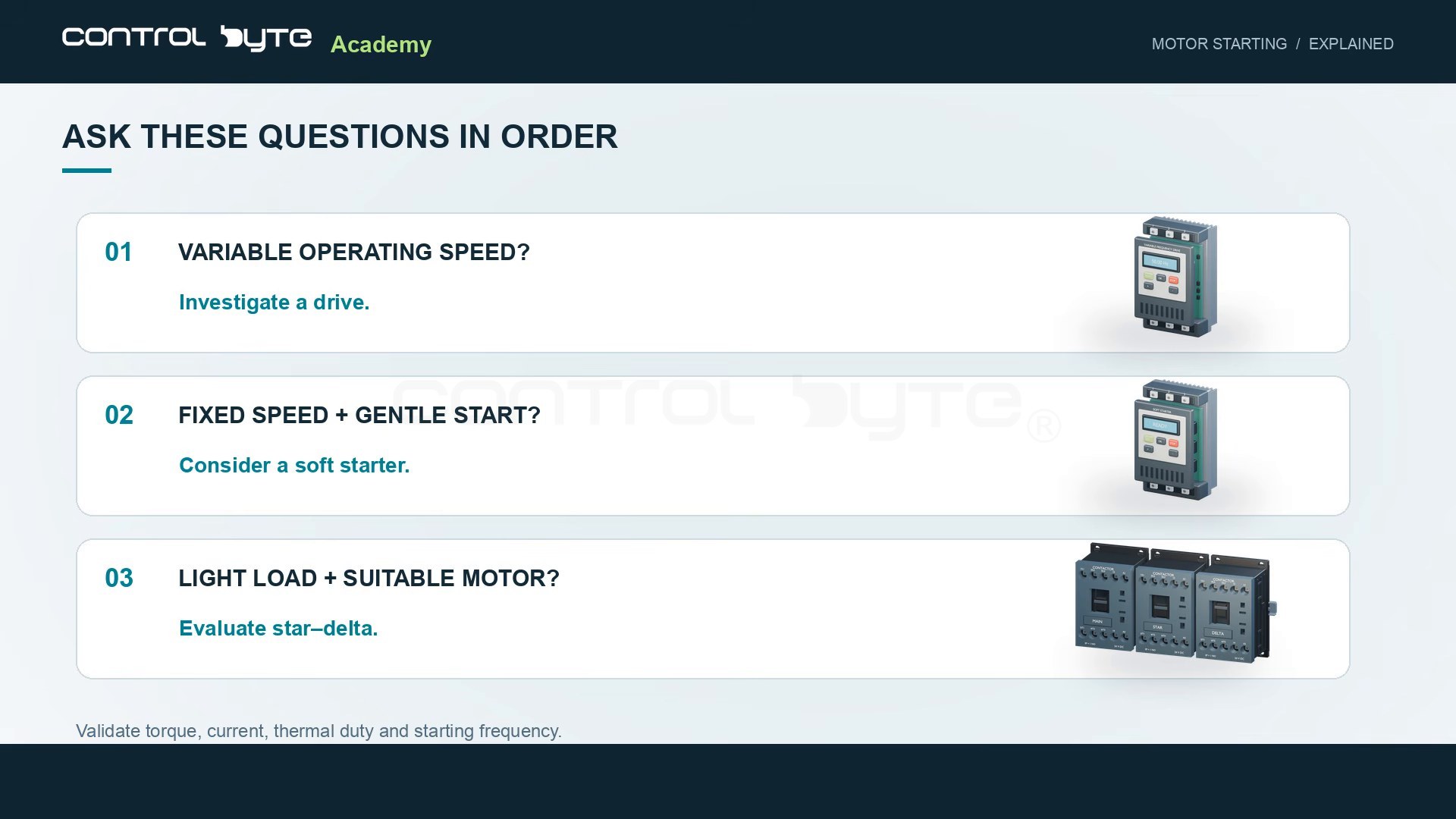
This sequence helps you select equipment from the needs of the process, rather than trying to make the process fit a device.
FAQ
Is a soft starter better than a star-delta starter?
Not always. A soft starter gives an adjustable start profile and often a controlled stop, without the changeover transient of star-delta. Star-delta is simpler and can be cheaper for lightly loaded, fixed-speed starts, but it needs a motor rated for delta on your supply voltage and six accessible winding ends.
Can a soft starter control motor speed?
No. A conventional soft starter controls only the effective voltage during starting and stopping. The supply frequency stays at 50 or 60 Hz, so the motor runs at a fixed speed. For speed control you need a VFD.
How much does star-delta reduce starting current?
In the ideal comparison with direct starting in delta, star-delta reduces the line starting current to about one third. The starting torque also drops to about one third, so the motor must still be able to accelerate the load.
When should I use a VFD instead of a soft starter?
Use a VFD when the process needs different operating speeds, continuous adjustment to demand (for example a fan or pump following flow), or advanced torque and braking functions. If you only need a gentle start at fixed speed, a soft starter is usually enough.
Summary
Keep three ideas in mind when you compare star-delta vs soft starter vs VFD:
- Star-delta changes the winding connection.
- A soft starter controls the effective voltage during starting.
- A variable frequency drive controls the motor supply frequency and voltage throughout operation.
The right choice gives the load enough torque while respecting the electrical supply and the machine's operating requirements.