How to find a job as an automation engineer (or robotics engineer) and actually get replies? The automation market in 2026 is short of skilled hands, yet plenty of candidates still hear nothing back. Because recruiters and ATS software filter applications on very specific competencies and keywords. In this guide we show, step by step, where to actually look for openings, how the person on the other side thinks, we break down a real automation engineer CV built around the Siemens ecosystem (S7-1200/1500, WinCC, TIA Portal), and we give you a ready skills checklist that employers expect.
This is part of our automation career series. If you are just starting out, read How to Get a Job as a PLC Programmer Without Experience, if you are weighing learning paths see PLC Bootcamp vs Self-Study vs University, and to make your code portfolio shine read GitHub for Automation Engineers and PLC Programmers.
The 2026 automation job market: what recruiters really want
Before you start your automation engineer job search, you need to know what the other side looks at. Hundreds of job ads point to the same recurring requirements, clustered around Siemens controllers because they dominate industrial plants across Europe.
- Siemens PLC programming: STEP 7 and TIA Portal, S7-300/400 and S7-1200/1500.
- HMI/SCADA visualization: WinCC (Comfort, Advanced, Unified) and SIMATIC operator panels.
- Industrial networks: PROFINET, PROFIBUS, increasingly Modbus TCP and OPC UA.
- Reading electrical schematics and EPLAN basics.
- Commissioning and diagnostics: machine start-ups on site, fault finding under time pressure.
- English at min. B2 (a second language is a bonus) and willingness to travel.
For senior roles employers usually expect 3 to 5 years of experience, knowledge of Safety (F-PLC, ISO 13849), plus SINAMICS drives and Motion Control. We collect the full list into a checklist below, but first, here is how your CV even reaches a human.
How recruiters think and how the ATS works
In larger companies your CV is first read not by a person but by an ATS (Applicant Tracking System) that scans the document for keywords from the job ad. If the ad says TIA Portal and S7-1500 but you only wrote PLC controllers in general, the algorithm may score you lower. Only after that filter does a recruiter look at the CV, usually for a dozen seconds.
- The first 6 seconds: the recruiter looks for the job title, industry and specific technologies. Put them at the very top.
- Match to the ad: the more phrases from the posting your CV covers, the higher you rank on the shortlist.
- Credibility signals: machine names, numbers, projects and certificates matter more than adjectives about yourself.
Automation engineer vs robotics engineer: two paths, different demands
Although the two roles are often lumped together, recruiters tell them apart. Know which way you point your CV, because different keywords attract different offers.
- Automation engineer / PLC programmer: works with controllers (Siemens, Allen-Bradley, Beckhoff), HMI/SCADA, networks and drives. The core is control logic and process visualization.
- Robotics engineer / robot programmer: handles trajectories, tooling (grippers, welding, palletizing), vision and integrating the robot into the line.
If robotics pulls you, learn the language of a specific vendor, because those are the names that show up in job ads:
- KUKA: KRL language, WorkVisual environment.
- FANUC: TP and Karel, simulation in ROBOGUIDE.
- ABB: RAPID language, RobotStudio.
- Yaskawa: INFORM, MotoSim.
- Cobots (Universal Robots): URScript, a fast-growing segment.
In practice the strongest candidates combine both: they can program the supervisory PLC in TIA Portal and link it to a robot over PROFINET. If you specialize, go deep in 1 to 2 leading environments rather than knowing everything superficially.
Where to find automation engineer jobs: proven sources
A great CV is wasted if you send it to the wrong places. These channels actually generate interviews in automation, ordered from the most obvious:
- General job boards: Indeed, LinkedIn Jobs. Filter for PLC, TIA Portal, WinCC and set email alerts so you can apply on day one.
- Industry communities: LinkedIn groups, automation forums and vendor user groups.
- System integrators and OEMs directly: their Careers pages often never hit the big boards.
- Specialist recruitment agencies for engineering and industry, plus firms that post engineers to projects abroad.
- Your LinkedIn profile: load it with keywords (Siemens, TIA Portal, SCL) and stay active so recruiters find you.
- Trade fairs and webinars: face-to-face contact shortens the path to a technical interview and skips the ATS.
Automation engineer skills checklist recruiters expect
Below are the most requested competencies, split into the foundation (must have) and the extras that set you apart (nice to have). Whatever is missing here is your to-do list for the coming months.
| Area | Must have (foundation) | Nice to have (edge) |
|---|---|---|
| PLC | TIA Portal, S7-1200/1500, LAD/FBD | SCL, classic STEP 7, GRAPH |
| HMI/SCADA | WinCC Comfort/Advanced | WinCC Unified, Ignition, Zenon |
| Networks | PROFINET, PROFIBUS | Modbus TCP, OPC UA, IO-Link |
| Drives | VFDs, SINAMICS basics | Motion Control, servo drives |
| Safety | Machine safety basics | F-PLC, ISO 13849, PL categories |
| Robots | PLC integration basics | KUKA, FANUC, ABB, cobots |
| Other | Schematics, commissioning, English B2 | EPLAN, Python/IIoT, second language |
Fill in the interactive automation engineer skills checklist, tick what you already know, and see which competencies recruiters look for. Takes 3 minutes.
Take the skills checklist »How much does an automation engineer earn in 2026
Pay depends on seniority, tech stack and willingness to travel, and it varies a lot by country (the US and Western Europe sit at the top). The table below gives indicative gross figures for Europe. Robot programmers on long site assignments, especially in automotive, tend to earn the most.
| Level | Indicative gross / year (EU) | What drives it |
|---|---|---|
| Junior (0-2 yrs) | EUR 30k - 45k | TIA Portal basics, eagerness to learn |
| Mid (2-5 yrs) | EUR 45k - 65k | independent commissioning, WinCC, networks |
| Senior (5+ yrs) | EUR 65k - 90k | Safety, Motion Control, project lead |
| Robot programmer / travel | EUR 70k - 100k+ | vendor certs, site work, languages |
Sample automation engineer CV (Siemens S7-1200/1500, WinCC)
Enough theory. Here is a sample mid-level automation engineer CV focused on the Siemens ecosystem. It is deliberately solid but not perfect, because we will break down its strengths and weaknesses next and show how to rewrite it.
Profile: Automation engineer with 4 years of experience programming Siemens controllers and commissioning packaging machinery. Focus: TIA Portal, S7-1500, WinCC visualization. Ran independent start-ups at customer sites across the UK and Germany.
Skills
TIA Portal (V15-V20) · S7-1200 / S7-1500 · LAD / FBD / SCL · WinCC Comfort and Advanced · PROFINET, PROFIBUS · Modbus TCP · SINAMICS G120 drives · Safety basics (F-PLC) · reading EPLAN schematics · Factory IO · English (native), German B1
Experience
Automation Engineer, PackTech Integration (2022 - present)
Programmed packaging lines on S7-1500, built WinCC Advanced visualizations, PROFINET communication with drives and robots, customer-site commissioning and service support.
Junior PLC Programmer, ElectroSystems (2020 - 2022)
Control-cabinet retrofits, S7-1200 programming, Comfort HMI panels, Factory IO testing, documentation.
Education
BEng, Automation and Control Engineering (2020)
Projects
Palletizer controlled by S7-1500 with WinCC visualization and Factory IO simulation. Mixer retrofit migrating from S7-300 to S7-1500.
Automation engineer CV review: what works and what to fix
This CV is solid and will pass the recruiter's first filter, but it is leaving easy wins behind.
Strengths:
- The right keywords: TIA Portal, S7-1500, WinCC, PROFINET. Exactly the phrases ATS systems and recruiters scan for.
- A clear ecosystem: a defined Siemens specialization instead of a vague jack-of-all-trades.
- A projects section: the palletizer and retrofit show real deployments, not just duties.
- Commissioning experience and travel to Germany, which scores highly.
What to fix:
- No numbers: the bullets are pure duties with no outcome. Metrics build credibility and catch the recruiter's eye.
- Generic profile: the opening line should lead with a result, not just a tool list.
- Safety too shallow: Safety basics is not enough if you aim higher. Add concrete context (e.g. PL categories per ISO 13849).
- No portfolio: a GitHub link or a short Factory IO project video sets you apart.
- Certificates: no proof (SITRAIN, completed courses). Even an online course with a certificate raises a CV's value.
The biggest fix is turning duties into achievements with numbers. See the difference on bullets from this very CV:
| Weak (duty) | Strong (achievement with a number) |
|---|---|
| Programmed packaging lines on S7-1500 | Programmed and commissioned 6 packaging lines on S7-1500, cutting start-up time by 20% |
| WinCC Advanced visualizations | Designed WinCC Advanced screens for 3 machines, reducing nuisance operator alarms by 30% |
| Service support | Introduced remote PROFINET diagnostics, cutting typical line downtime from 4 h to 45 min |
The most common automation engineer CV mistakes
These slip-ups repeat across hundreds of applications and can knock out a good candidate at the start:
- A wall of text with no headings or lists that cannot be scanned in a dozen seconds.
- Vague phrasing like PLC knowledge instead of specific models and software versions.
- A 3-page CV for someone with 4 years of experience. Aim for 1, at most 2 pages.
- Percentage skill bars (TIA Portal 80%) that mean nothing to a technical recruiter.
- A non-PDF file that breaks formatting inside the ATS.
- Typos in tech names: misspelling PROFINET, SINAMICS or SCL undermines credibility.
How to write an automation engineer CV for ATS and recruiters
- Keywords from the ad: copy controller and software names exactly as written (S7-1500, not just PLC).
- ATS-friendly format: single column, standard headings, PDF, no graphics or tables that block parsing.
- Achievements, not duties: start each bullet with a verb and add the outcome with a number.
- Projects section: 2 to 3 deployments with the technology stack and your specific role.
- Tailor per role: one version for maintenance, another for a PLC programming role.
- Portfolio: add a link to GitHub, a Factory IO project or a short video of a working application.
LinkedIn and cover letters: do you need them
In automation a classic cover letter rarely makes the difference, but a well-run LinkedIn profile does. That is where recruiters actively hunt for candidates.
- Profile headline with your role and tech: PLC Automation Engineer, Siemens TIA Portal, WinCC.
- Experience and Projects sections consistent with your CV, using the same keywords.
- Activity: short posts about your deployments build visibility better than silence.
- Cover letter: write one only when the ad asks for it, and keep it to 3 sentences on your fit for that specific machine or industry.
Automation engineer interview: common questions
When your CV works, prepare for the technical round. The usual suspects:
- The PLC scan cycle and the difference between OB, FB and FC blocks.
- Contactor vs relay, and motor starting methods.
- PROFINET configuration and communication diagnostics.
- Data types and addressing in TIA Portal, retain markers, optimized blocks.
- How you would approach fault finding on a line you have never seen.
- Safety basics: what a safety category and Performance Level mean.
Answer with the STAR method (situation, task, action, result) and always tie back to a concrete project from your CV. That is why the projects section earns its place: it gives you ready-made interview stories.
Frequently asked questions (FAQ)
How much does an automation engineer earn?
It varies by country and seniority. Juniors start lower, mid-level engineers sit in the comfortable middle, and seniors with strong Siemens and Safety skills earn the most, often boosted by travel and commissioning allowances. See the table above for indicative ranges.
Do you need a degree to work in automation?
A degree helps, especially an engineering title for work abroad, but practical skills matter most. A strong project portfolio and TIA Portal fluency often outweigh the diploma alone.
How do you find a job as an automation engineer with no experience?
Build 2 to 3 projects in a simulator (Factory IO, PLCSIM), show them on GitHub or video, earn a PLC course certificate, and apply for junior roles and integrator internships. A practical portfolio makes up for missing work history.
Which certificates are worth having as an automation engineer?
The most valued are Siemens SITRAIN courses, robot-vendor certificates (KUKA, FANUC, ABB), and completed PLC programming courses with a hands-on project and a certificate.
Automation engineer or robotics engineer: which to choose?
If you enjoy control logic and visualization, take the PLC path. If trajectories, motion and cell integration excite you, go for robotics. The strongest move is to master one deeply and add the basics of the other.
Summary
A successful automation engineer job search rests on three things: the right channels to reach openings, a CV loaded with the right Siemens-ecosystem keywords, and real skills you can defend in an interview. Rewrite duties into achievements with numbers, tailor the document to each ad, and build a portfolio. Fill in our checklist, find your gaps, and close them before the next applicant does.
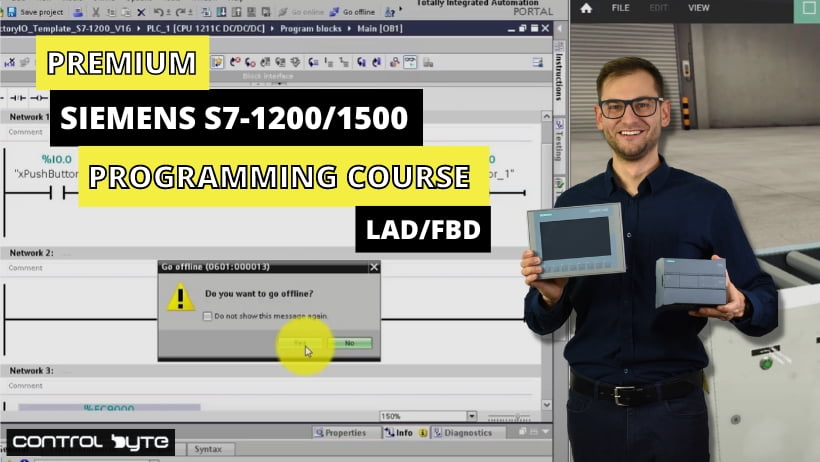
The fastest way to close gaps in Siemens S7-1200/1500 and WinCC, and to get a project for your CV, is a hands-on course with a certificate:
Author